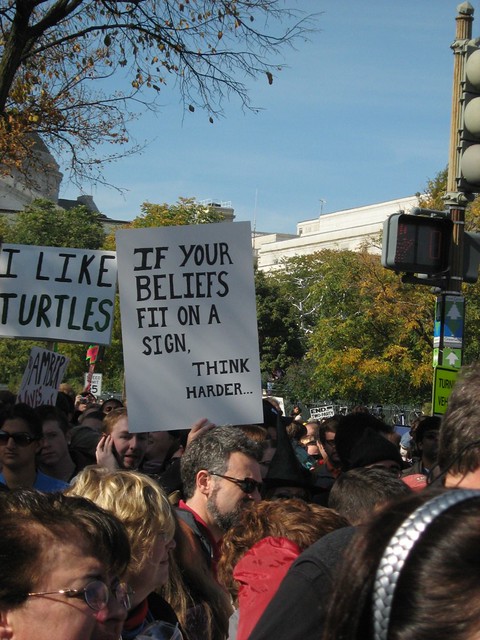
I went with a group to the West Coast Walk For Life yesterday. I consider myself pro-life, but I'm not very ... militant ... about it. Don't get me wrong, I think there is something very powerful and worthwhile in being on the front-lines of the battle. We need those people. I'm not sure if I'm one of them at the moment. It may be a calling thing or it might just be that my heart isn't convicted enough about it yet. Personally, I prefer battling it out through teaching on it and engaging with people one on one about it. I feel like I can communicate and dialogue about it in a much more productive manner. Maybe it has to do with my non-confrontational (Chinese) nature. But either way, I was out there walking yesterday.
It was pretty powerful to see the vast amounts of people and there were a few interesting things that stood out to me.
1. With all the talk about life and anti-abortion, I was surprised that there was no talk about sex. It's weird to me that you can talk about what people do as the result of having sex without actually talking about sex. Maybe it's too risque with kids around and "sex" being "adult content," but there's gotta be a way to do it without triggering peoples' fears of awkward conversations on the birds and the bees? With media bombarding us constantly with sex and sexualized images, if we never talk about it as a group in a wholesome way, can we ever combat it? I saw a lot of teenagers there and I couldn't help but think that there is likely a number of them that may find themselves facing the hard decision of whether or not to keep the baby. I dunno. I just think it's helpful to connect abortion and sex on the activist front.
2. Debriefing the experience with the group I went with, the most memorable part for people were the counter-protesters. Many of them were quite out there in terms of the way they dressed - classic San Franciscans (think PRIDE). What's interesting about it is that you really only saw them over a very small part (maybe one block) of the two mile walk, but they were the most memorable part. Watching the pro-lifers walking by watching the pro-choice protesters, there were lots of interested looks, picture-taking, the occasional shouting match, and lots of misunderstanding on both sides. I did, however, hear a few passing comments on both sides of interest and/or agreement (if only partial) of certain signs which brings me to my last thought.
3. The signage for the most part did not impress me. A lot of it on the pro-life side was the same-old rhetoric (is that bad of me to say?). There were some occasional good signs on both sides and by good I mean creative, sharp, or in-your-face. I even think that my group had a few of the better signs out there (I'm probably biased). But maybe I don't really understand the point of signs. Based on the event itself, it's already clear where people in the walk stand and so it should already be understood that the issue is divisive. Wouldn't it be more helpful for some of the signage to help build bridges or even just to ease some of the tension unto helping bring about some understanding that there are people on both sides, not just a faceless enemy? I'm thinking next year, I will make a big sign out of white board (dry-erase) material so that I can have rotating material. If I had one this year, the following might've made it on:
"Go Giants!"
I may have missed the boat on this one. Who knows if we'll have World Series solidarity next year.
"Chinese Catholics. Yes, we exist. Yes, most of us are single."
Sorry, just a bit of remaining bitterness and wanting to be noticed in a crowd.
"I love Jesus & I love sex!"
This should be worth a high-five or two.
Sunday, January 23, 2011
Friday, January 21, 2011
Thursday, January 20, 2011
Reading Anti-Catholic Books
Being someone who loves the Catholic Church, but also had significant faith formation in the Evangelical church, the whole Catholic/Protestant discussion is one that's close to my heart. Books have played a huge role in my love for the Church, particularly those by Scott Hahn, but I have also tried to keep a balanced and open view by reading anti-Catholic books as well, most of which were passed on to me by Protestant friends or family (incidentally, I'm not sure if a few of them actually read the books they recommended). In the past, I've read books like Another Jesus and just finished Once a Catholic. I'm also about to start Preparing Catholics for Eternity.
For me, it's not always easy to read a book from a differing view point than my own (like The God Delusion), but it's an exercise which I find satisfaction in afterwards. I don't consider myself particularly intellectual or an excellent apologist. I know enough to where I stand firm in my faith, though there's always more to learn, and I can talk intelligently about it.
As a result, reading these types of books is always a bit of an internal wrestling match for me. I suppose my initial stance is something like this. When I come across a point that's easily refutable, it's easy to feel self-satisfied and vindicated - "*roll my eyes* See? That's why my faith is the right one!" On the other hand, when I come across a point that seems valid and I can't think of a counter-argument, it's easy for me to want to blow past the section pretending I didn't see it or think that there has to already be a refutation from someone smarter than me or have a momentary flash of, "What if I've been wrong all along?" which is what I think the authors really want.
It's interesting to me to observe my own default disposition when it comes to this type of reading. Obviously, I'll come in with my critical eye on because I know that there are lots different agendas, world views, and experiences out there that I need to be weary of. I also know that if that's my only approach, there's also a whole side of the human experience that I'll miss and to be honest, it can get very tiring. It can be very nice to read things that don't trigger the critical eye and to take in information as fact or sub-consciously absorb it without question. Sometimes, I just want to read something and let it speak to me in all my subjective glory and not worry about all the different arguments on both sides. At the same time, absorbing everything unquestioningly is scary to me. Where is the balance in the middle?
For me, it's not always easy to read a book from a differing view point than my own (like The God Delusion), but it's an exercise which I find satisfaction in afterwards. I don't consider myself particularly intellectual or an excellent apologist. I know enough to where I stand firm in my faith, though there's always more to learn, and I can talk intelligently about it.
As a result, reading these types of books is always a bit of an internal wrestling match for me. I suppose my initial stance is something like this. When I come across a point that's easily refutable, it's easy to feel self-satisfied and vindicated - "*roll my eyes* See? That's why my faith is the right one!" On the other hand, when I come across a point that seems valid and I can't think of a counter-argument, it's easy for me to want to blow past the section pretending I didn't see it or think that there has to already be a refutation from someone smarter than me or have a momentary flash of, "What if I've been wrong all along?" which is what I think the authors really want.
It's interesting to me to observe my own default disposition when it comes to this type of reading. Obviously, I'll come in with my critical eye on because I know that there are lots different agendas, world views, and experiences out there that I need to be weary of. I also know that if that's my only approach, there's also a whole side of the human experience that I'll miss and to be honest, it can get very tiring. It can be very nice to read things that don't trigger the critical eye and to take in information as fact or sub-consciously absorb it without question. Sometimes, I just want to read something and let it speak to me in all my subjective glory and not worry about all the different arguments on both sides. At the same time, absorbing everything unquestioningly is scary to me. Where is the balance in the middle?
Monday, January 17, 2011
Chinese Dads are Asexual
Chinese parents suck at talking to kids about sex. I'm sure it's tough regardless of your ethnicity, but Chinese parents seem to extra suck at it. You add that to a modest culture and the fact that in society, up until recently, Chinese guys have been seen as asexual, and you get a tumultuous adolescence, particularly if you consider yourself a Christian.
There is lots of discussion on this topic so I won't go there this time, but there is a sub-topic that fascinates me. It's awkward for me to think about, but I can't for the life of me see a Chinese dad as a sexual being. It's already weird (and rare, I think) to see sexual situations in Asian media/dramas, but in real life it's even weirder. Recently, I was at a wedding where I heard that one of the dads in the wedding had cheated on the mom with her close friend. This was saddening, but not necessarily surprising since it's the type of drama you hear about a lot, especially on all these reality TV shows. However, then you remember that the dad we're talking about is someone like this:
and then it's like, "Whaaa..?!" You think all they care about is making money, making sure their offspring are successful, and solving engineering/math/medical problems. It's hard for me to think that they even have a horny bone in them. I don't think I've ever seen a Chinese dad check out another woman.
As I've gotten older and have come across more of our Chinese church gossip (which is a big problem, btw), there are lots of stories floating around about how various men have cheated. It's a sad (but not uncommon) situation, but I keep getting caught up on, "They...are out there....having sex?! *shiver* *dunks head in cold water*"
There is lots of discussion on this topic so I won't go there this time, but there is a sub-topic that fascinates me. It's awkward for me to think about, but I can't for the life of me see a Chinese dad as a sexual being. It's already weird (and rare, I think) to see sexual situations in Asian media/dramas, but in real life it's even weirder. Recently, I was at a wedding where I heard that one of the dads in the wedding had cheated on the mom with her close friend. This was saddening, but not necessarily surprising since it's the type of drama you hear about a lot, especially on all these reality TV shows. However, then you remember that the dad we're talking about is someone like this:
and then it's like, "Whaaa..?!" You think all they care about is making money, making sure their offspring are successful, and solving engineering/math/medical problems. It's hard for me to think that they even have a horny bone in them. I don't think I've ever seen a Chinese dad check out another woman.
As I've gotten older and have come across more of our Chinese church gossip (which is a big problem, btw), there are lots of stories floating around about how various men have cheated. It's a sad (but not uncommon) situation, but I keep getting caught up on, "They...are out there....having sex?! *shiver* *dunks head in cold water*"
Wednesday, January 12, 2011
Daily Exodus
Growing up as a guy, taking a crap in middle school/high school was always shameful for some reason. Like if someone heard you were going to take a dump, you would get made fun of. Flash forward 10-15 years to the working world. There are only two stalls on a floor of 100+ people. All the guys (I can't speak for the girls) seem to take a crap around the same time each day - 10AM and 1:30PM. I suppose it's because it's right after breakfast and right after lunch. I'm no exception. However, overcrowding is a weird experience. When we all make our exodus to the bathroom, it's awkward going inside the bathroom, see that both stalls are in use and have to go down a floor. It's awkward if there are people at the sink who see you walk in, react with disappointment when you see that the stalls are in use, and walk out of the bathroom. In their head you know they're thinking, "Yup, they need to take a crap." Same deal when you walk right back out of the bathroom to head to the elevator to explore other floors and see the same people who just saw you walk into the bathroom 10 seconds ago. They know you're taking a crap too. Lastly, it makes me want to kick in a door when you discover the same thing on multiple floors. Adding the inconvenience factor to the urgency of bowel movements and it is hard to stay in a state or grace.
Friday, January 7, 2011
This Virgin Experience
It has been quite an interesting experience being a guy who saved sex until marriage. In our culture, it feels like there are less and less people who are in this group. What's more is that even within this group where "how far is too far" is a common struggle at some point, the way "saved sex until marriage" is defined can vary greatly. Oral sex may be seen as not "technically sex" or being naked together or some sort of dry humping, rubbing, whatever.
For me (I have no problems being honest), my "furthest" experience was passionate making out with my shirt off. I had never seen or felt a woman's boobs or vagina in the context of a romantic relationship (or outside for that matter - the feeling, definitely not the seeing) and the most naked I ever was with a woman, like I said, was with my shirt off which was mainly a way of toeing and playing with the line. I made a commitment to myself later that I wouldn't purposely be shirtless in front of the girl I was dating (who is now my wife) in order to titillate her. The "lack of experience" wasn't because the opportunity didn't afford itself. Sure, it started out with the whole "save sex until marriage" "indoctrination" growing up, but when I really began to question it, it eventually evolved into the awareness of my own selfish desires and power struggles, but also a deeper understanding of what physical intimacy, our bodies, and sex is all about (thank you, Theology of the Body).
Now that you have some sort of context with which to measure (or judge) me, it's probably clear that I don't have much of a problem discussing or talking about these things in general and as it relates to myself. My co-workers found that out real soon and what was quite interesting to me was how fascinated so many of them were that a real life virgin by choice was in their midst. What probably intrigued them more was that I was open about it and not afraid to discuss sexual things even with and among gay co-workers. I guess I didn't fit into any of the usual prude or whatever boxes.
Fittingly, once I got married, my co-workers were curious about what my experience was like and at one point when a few of them were having dinner, my first time wedding night experience became a topic of discussion and so they texted me some questions. Even better/worse, my wife and I practice NFP (Creighton Model) and are open about it. At dinner parties we host, our chart has been known to make appearances to great interest/disbelieving giddiness/uncertain excitement.
There are lots of things I've learned, realized, or understood more deeply since being married, but I'll share that at another time.
For me (I have no problems being honest), my "furthest" experience was passionate making out with my shirt off. I had never seen or felt a woman's boobs or vagina in the context of a romantic relationship (or outside for that matter - the feeling, definitely not the seeing) and the most naked I ever was with a woman, like I said, was with my shirt off which was mainly a way of toeing and playing with the line. I made a commitment to myself later that I wouldn't purposely be shirtless in front of the girl I was dating (who is now my wife) in order to titillate her. The "lack of experience" wasn't because the opportunity didn't afford itself. Sure, it started out with the whole "save sex until marriage" "indoctrination" growing up, but when I really began to question it, it eventually evolved into the awareness of my own selfish desires and power struggles, but also a deeper understanding of what physical intimacy, our bodies, and sex is all about (thank you, Theology of the Body).
Now that you have some sort of context with which to measure (or judge) me, it's probably clear that I don't have much of a problem discussing or talking about these things in general and as it relates to myself. My co-workers found that out real soon and what was quite interesting to me was how fascinated so many of them were that a real life virgin by choice was in their midst. What probably intrigued them more was that I was open about it and not afraid to discuss sexual things even with and among gay co-workers. I guess I didn't fit into any of the usual prude or whatever boxes.
Fittingly, once I got married, my co-workers were curious about what my experience was like and at one point when a few of them were having dinner, my first time wedding night experience became a topic of discussion and so they texted me some questions. Even better/worse, my wife and I practice NFP (Creighton Model) and are open about it. At dinner parties we host, our chart has been known to make appearances to great interest/disbelieving giddiness/uncertain excitement.
There are lots of things I've learned, realized, or understood more deeply since being married, but I'll share that at another time.
Thursday, December 30, 2010
Fake Out Proposal
Among my broader circle of friends and acquaintances who are getting their marriage on, I’ve noticed a mini-trend. When the guys are imminently planning to propose to their girlfriend, it seems that inevitably, one of the ideas that gets tossed around is some sort of fake out where the guy will make the girl think he is about to propose and then doesn’t.
First, some background. In this broad circle (my wife and I included), it is very common for couples to go through some sort of pre-engagement counseling in addition to a pre-marital program. Now pre-marital counseling is nothing new, but pre-engagement counseling seems to be a newfangled thing. Impersonally, it seems to be a pervading value to make the best decision possible with the most information possible. More appropriately, couples usually do it to grow more deeply in their own understanding of self as well as explore more deeply the dynamics of their relationship.
As an aside, I highly recommend it as it was really helpful to “ask the hard questions” outside the context of being “locked in” (ie. a ring) and without the added overhead and the all-consuming process of planning a wedding. Said another way, it was helpful to prepare for a marriage instead of just preparing for a wedding.
Anyhow, doing so much relational processing as a couple will often times take out most, if not all, of the surprise of getting engaged assuming the couple discerns that they will be getting married (it would probably be a shock if they broke up). However, inevitably, the guy will still have some traditionalist sense of wanting to surprise his girl and it seems that the only way to reintroduce any surprise is to try and throw her off the trail.
This is why I think some sort of fake out idea is always tossed around. “I know she knows we’re getting married so if I ‘help’ her continue to think she knows what’s coming and then BOOM! not do anything, then I’ll be in the clear. Problem solved.”
I’m not saying that a fake out always ends up making the final cut. Sometimes, another female is introduced somewhere along the way who provides perspective for how extremely emotional it can be for a girl. But it seems that guys should get a little credit for wanting to keep some chivalry be it a bit misguided.
First, some background. In this broad circle (my wife and I included), it is very common for couples to go through some sort of pre-engagement counseling in addition to a pre-marital program. Now pre-marital counseling is nothing new, but pre-engagement counseling seems to be a newfangled thing. Impersonally, it seems to be a pervading value to make the best decision possible with the most information possible. More appropriately, couples usually do it to grow more deeply in their own understanding of self as well as explore more deeply the dynamics of their relationship.
As an aside, I highly recommend it as it was really helpful to “ask the hard questions” outside the context of being “locked in” (ie. a ring) and without the added overhead and the all-consuming process of planning a wedding. Said another way, it was helpful to prepare for a marriage instead of just preparing for a wedding.
Anyhow, doing so much relational processing as a couple will often times take out most, if not all, of the surprise of getting engaged assuming the couple discerns that they will be getting married (it would probably be a shock if they broke up). However, inevitably, the guy will still have some traditionalist sense of wanting to surprise his girl and it seems that the only way to reintroduce any surprise is to try and throw her off the trail.
This is why I think some sort of fake out idea is always tossed around. “I know she knows we’re getting married so if I ‘help’ her continue to think she knows what’s coming and then BOOM! not do anything, then I’ll be in the clear. Problem solved.”
I’m not saying that a fake out always ends up making the final cut. Sometimes, another female is introduced somewhere along the way who provides perspective for how extremely emotional it can be for a girl. But it seems that guys should get a little credit for wanting to keep some chivalry be it a bit misguided.
Subscribe to:
Posts (Atom)
